
What Is a Broker and What Does a Broker Do?
Learn what a broker does, how customer orders reach financial markets, how brokerage firms earn money, and how brokers differ from advisers.
A broker is a firm or financial professional that helps customers buy and sell securities such as stocks, bonds, exchange-traded funds and other investments. In modern markets, a broker typically receives an investor’s order, determines where that order can be executed, and handles the transaction through market infrastructure that most investors never see directly.
Some brokers also provide investment recommendations, research, account tools, margin services or other financial products. The exact role depends on the broker’s business model and the services offered.
A broker should not be confused with a stock exchange or with an investment adviser. Brokers provide access to markets and execute securities transactions, while exchanges are trading venues and investment advisers generally provide ongoing portfolio advice or management.
What Is a Broker?
A broker acts as an intermediary between an investor and financial markets.
When an investor wants to purchase shares of a public company, the investor usually does not connect directly to an exchange and search manually for another person willing to sell.
The order is submitted to a broker.
The broker then handles the process required to send that instruction toward an appropriate execution venue.
Depending on the security and the firm’s systems, the order could interact with:
- a stock exchange;
- a market maker;
- an electronic trading venue;
- another part of the brokerage firm;
- other market infrastructure.
From the customer’s perspective, this process can appear almost instantaneous.
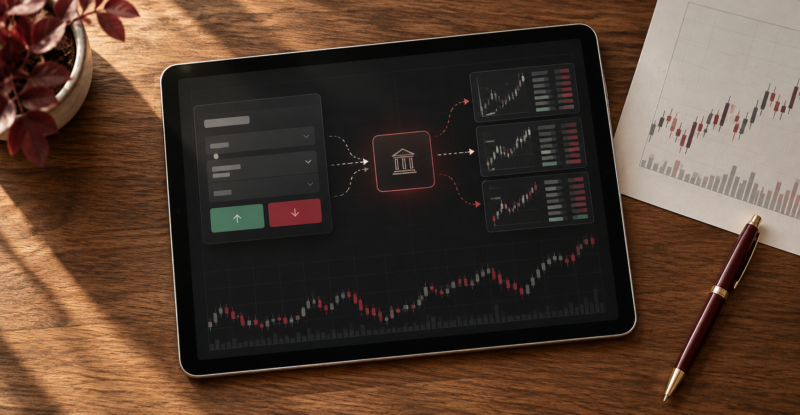
Behind a simple Buy or Sell button, however, multiple systems may be involved in order routing, execution, clearing, settlement and recordkeeping.
What Does a Broker Do?
The most basic function of a broker is to accept and execute customer trading instructions.
A modern brokerage firm may perform several additional functions.
| Broker Function | What It Means for the Investor |
|---|---|
| Account access | Provides an account through which eligible investments can be held or traded |
| Order handling | Receives instructions to buy or sell securities |
| Order routing | Determines where an order may be sent for execution |
| Trade reporting | Records executed transactions and provides confirmations |
| Market data | May provide quotes, charts and trading information |
| Research | Some firms provide company, market or investment research |
| Recommendations | Some brokers recommend investments or investment strategies |
| Margin services | Eligible customers may be able to borrow against account assets |
Not every broker provides every service.
An execution-focused online broker may primarily offer trading technology and account infrastructure, while another firm may combine brokerage services with financial professionals who make recommendations to customers.
How Does a Broker Execute a Stock Trade?
The role of a broker becomes clearer when following one transaction from beginning to end.
Suppose an investor wants to purchase 50 shares of a hypothetical company.
1. The Investor Submits an Order
The investor signs into a trading platform and selects the security.
The order normally includes information such as:
- whether the investor wants to buy or sell;
- the number of shares;
- the order type;
- any applicable price conditions;
- the duration of the order.
The investor then submits the instruction to the brokerage firm.
2. The Broker Receives the Instruction
The brokerage system checks the order and relevant account conditions.
For example, the firm may need to confirm that sufficient buying power or securities are available to support the transaction.
The exact checks depend on the account, order and security involved.
3. The Broker Routes the Order
The broker generally has choices about where an order can be sent.
An exchange-listed stock does not necessarily have to execute on the exchange most closely associated with its listing.
An order may instead be routed to another exchange, a market maker or another eligible trading venue.
For the customer, this matters because routing can influence:
- execution price;
- speed;
- probability of execution;
- opportunities for price improvement.
4. The Trade Executes
Execution occurs when compatible buying and selling interest meets.
The investor then receives an execution price for the shares purchased or sold.
The price visible before the order was submitted is not always the exact price received.
Markets continue moving while the instruction is being processed, and available quantities at each price can change rapidly.
5. The Transaction Moves to Clearing and Settlement
Execution is not the final operational step.
After the trade occurs, financial infrastructure still needs to determine obligations and complete the transfer of cash and securities.
Much of this process is invisible to the retail investor because the brokerage account handles the operational details.
Broker vs Stock Exchange
A broker and an exchange perform different functions.
A broker is the intermediary through which an investor generally submits an order.
A stock exchange is an organized trading venue where securities can be bought and sold according to established market rules.
| Feature | Broker | Stock Exchange |
|---|---|---|
| Main relationship | Works with customers | Provides trading venue infrastructure |
| Accepts retail orders directly? | Typically yes | Generally through market participants |
| Maintains customer accounts? | Often | No retail brokerage account |
| Routes orders? | Yes | Receives eligible orders for trading |
| Examples of activity | Account services and execution | Order matching and market operation |
The distinction helps explain why opening an online trading app does not mean an investor has created a direct personal connection to an exchange.
Broker vs Dealer
The term broker-dealer combines two roles that can occur within the same financial firm.
When a firm acts as a broker, it generally handles a securities transaction on behalf of a customer.
When acting as a dealer, the firm can transact for its own account.
For example, a dealer may hold securities in inventory and sell them to customers rather than simply finding another market participant to take the opposite side of the transaction.
The same organization can perform both functions, which is why the regulatory term broker-dealer is common in U.S. securities markets.
Broker vs Investment Adviser
Brokers and investment advisers can both help investors, but the typical relationships are different.
| Feature | Brokerage Relationship | Advisory Relationship |
|---|---|---|
| Primary focus | Transactions and brokerage services | Ongoing investment advice or management |
| Trading | Accepts and executes customer orders | May manage or advise on portfolio decisions |
| Recommendations | May recommend securities or strategies | Generally provides ongoing advice |
| Monitoring | Depends on the agreement | Typically more continuous |
| Common compensation structure | Can include transaction-based compensation | Often asset- or service-based fees |
The distinction is not always obvious because one financial company can offer both brokerage and advisory services.
A financial professional may also be licensed to work in both capacities.
Investors should therefore understand which service they are receiving for a particular account or recommendation rather than relying only on a job title.
What Is a Brokerage Account?
A brokerage account is an account that allows an investor to hold and transact in investments supported by the brokerage firm.
The available investments can vary but commonly include securities such as:
- stocks;
- bonds;
- ETFs;
- mutual funds;
- options, where approved;
- other eligible financial products.
The account is the investor-facing structure through which cash and investments are recorded.
The broker is the firm providing the brokerage service.
Our guide to a brokerage account explains account types, cash balances, trading access and other practical details in more depth.
What Types of Brokers Are There?
The word broker covers several different business models.
Online Brokers
Online brokers allow investors to manage accounts and place trades primarily through websites and mobile applications.
These firms often emphasize:
- self-directed trading;
- digital account management;
- market data;
- research tools;
- automated order entry.
The investor generally makes the individual investment decisions.
Full-Service Brokers
A full-service brokerage relationship may include greater access to financial professionals, investment recommendations, research and other services.
The additional service can involve a different fee structure from a primarily self-directed platform.
Discount Brokers
The term discount broker traditionally describes firms that focus on lower-cost trade execution with fewer individualized services.
The distinction has become less clear as many online brokerage platforms now offer extensive research, educational material and additional financial services while maintaining low direct trading commissions for some products.
Introducing and Clearing Brokers
Some brokerage firms interact directly with customers but rely on another firm for parts of trade clearing, custody or account operations.
The customer may see the name of one broker while another financial institution performs important infrastructure functions behind the scenes.
This arrangement demonstrates why the visible brokerage brand is only one component of the market system.
How Do Brokers Make Money?
Brokerage services are not necessarily free simply because a platform advertises zero commission on certain trades.
Broker revenue can come from several sources.
Trading Commissions
A broker may charge a direct commission when a customer buys or sells a security.
The fee can be fixed or related to the size or type of transaction.
Markups and Markdowns
When a broker-dealer sells securities from its own inventory or purchases securities from a customer, compensation can sometimes be reflected in the transaction price.
Interest on Cash
Brokerage firms may earn income related to customer cash balances depending on how those balances are handled.
Margin Interest
Customers approved for margin can borrow money from the brokerage firm to purchase securities or support certain trading activities.
The broker charges interest on that borrowing.
Because leverage can amplify both gains and losses, investors considering this feature should understand margin trading and leverage before borrowing against an account.
Payment for Order Flow
In some market structures, a trading venue or market maker can compensate a broker for routing customer orders to it.
This arrangement can create an economic relationship between the brokerage firm and the destination receiving the order.
It does not mean that an investor automatically receives poor execution, but it is one reason order-routing practices and conflicts of interest deserve attention.
Account and Service Fees
Depending on the brokerage firm, investors can also encounter charges for services such as:
- account transfers;
- special trading products;
- wire transfers;
- data subscriptions;
- certain mutual fund transactions;
- professional services.
The absence of a headline stock commission therefore does not mean the economic cost of using a broker is zero.
What Is Best Execution?
When a broker handles customer orders, execution quality involves more than simply sending the trade somewhere quickly.
In the United States, broker-dealers have a duty to seek the best execution reasonably available under the circumstances.
Relevant factors can include:
- available price;
- speed of execution;
- likelihood of execution;
- opportunities for price improvement;
- market conditions.
This does not guarantee that every customer order receives the theoretically best possible result in hindsight.
Markets can change continuously, and different venues can offer different combinations of price and execution probability.
The obligation instead requires brokers to evaluate execution arrangements rather than routing orders without regard to customer outcomes.
Why Order Type Matters
A broker can only execute the instruction the customer actually provides.
The order type therefore affects the trade.
Market Order
A market order prioritizes execution at available market prices.
The investor does not receive a guarantee that the execution price will equal the quote visible before the trade was submitted.
Limit Order
A limit order establishes a price boundary.
A buy limit specifies the maximum price the investor is willing to pay, while a sell limit establishes the minimum acceptable selling price.
The tradeoff is that the order may never execute.
Stop Order
A stop order becomes active after a specified trigger price is reached.
Different brokerage firms can offer different order types and variations, so investors should understand the specific rules applied by their platform.
Our guide to stock market terminology explains common order, liquidity, spread and market terms that appear on brokerage platforms.
Why the Price on a Broker Screen Is Not Always the Execution Price
A displayed quote describes current market information, not a promise that unlimited shares are available at that exact level.
Imagine a stock shows an ask price of $30.00.
The available sell orders might actually look like this:
| Shares Available | Ask Price |
|---|---|
| 100 | $30.00 |
| 300 | $30.04 |
| 600 | $30.10 |
A customer trying to buy 50 shares could potentially execute entirely at the first price.
An immediate order for 1,000 shares might need to interact with several price levels.
The difference is caused by available liquidity rather than by the broker arbitrarily changing the quoted price.
A Practical Example of What a Broker Does
Consider an investor named Jordan who wants to purchase 100 shares of a fictional company called Summit Industrial.
The stock currently trades near $42.
Jordan opens the broker’s trading platform and enters an order to buy 100 shares.
The process can be simplified into the following sequence:
- Jordan enters the trading instruction.
- The brokerage system receives and validates the order.
- The broker determines where the order can be routed.
- The order reaches a trading venue or liquidity provider.
- Compatible sell interest is found.
- The trade executes at the available price or prices.
- The brokerage platform records the completed transaction.
- Clearing and settlement processes occur behind the scenes.
- Jordan’s account ultimately reflects ownership of the shares.
Jordan did not personally contact the stock exchange, find the seller or arrange settlement.
The brokerage relationship provided the infrastructure that made the transaction practical.
Can a Broker Recommend Investments?
Yes, some brokers can make recommendations about securities, investment strategies or account types.
However, an execution-only platform may provide tools and information without giving individualized recommendations.
The distinction matters because a recommendation creates different considerations from a self-directed transaction initiated entirely by the customer.
In the United States, Regulation Best Interest applies when a broker-dealer makes covered recommendations to a retail customer.
Under that standard, the broker-dealer must act in the retail customer’s best interest when making the recommendation and cannot place its own interests ahead of the customer’s interests.
Investors should still understand fees, conflicts and the scope of the relationship rather than assuming that every brokerage service includes ongoing portfolio management.
Does a Broker Monitor Your Portfolio?
Not necessarily.
A brokerage relationship can be primarily transactional.
An investor may open an account, select investments independently and use the firm mainly to execute trades and maintain the account.
Some brokers may agree to provide recommendations or periodic monitoring in certain relationships.
An investment adviser typically provides a more ongoing form of advice or portfolio management.
The exact obligation depends on the service agreement rather than the presence of a familiar financial brand.
What Should You Look for When Choosing a Broker?
The best broker depends on what the investor actually needs.
Several factors deserve attention.
Available Investments
Investors should confirm that the firm supports the securities and account types they intend to use.
A platform designed primarily for basic stock and ETF investing may not offer every bond, fund, option or international product.
Total Costs
Comparing brokers only by stock-trading commission can miss important expenses.
Potential costs include:
- commissions;
- spreads;
- margin rates;
- fund expenses;
- account fees;
- transfer charges;
- currency-conversion costs.
Execution Quality
For active traders in particular, execution quality can matter alongside advertised commissions.
A small difference in execution price repeated across many trades can become economically meaningful.
Platform Reliability
An investor should consider whether the platform provides dependable access when markets are volatile.
Features are less useful if an investor cannot reliably manage the account when needed.
Research and Tools
Some investors need only basic trading access.
Others value screeners, financial statements, market research, charting or portfolio-analysis tools.
Customer Support
Support can become especially important when dealing with account transfers, security restrictions, unusual corporate actions or access problems.
Regulatory Status and Disclosures
Investors should verify the regulatory status of the firm and financial professional rather than relying solely on advertising.
In the United States, registered firms serving retail investors provide disclosures that can help customers understand services, fees, conflicts and disciplinary history.
Why Form CRS Matters for U.S. Investors
Registered U.S. broker-dealers and investment advisers that serve retail investors generally provide a relationship summary known as Form CRS.
The document is designed to make several questions easier to evaluate, including:
- what services the firm provides;
- how fees and costs work;
- which conflicts of interest may exist;
- which standard of conduct applies;
- whether reportable disciplinary history exists.
Reading the relationship summary can be more useful than relying solely on the marketing page because it is specifically designed to describe the nature of the customer relationship.
Common Broker Misconceptions
A Broker Is the Same as a Stock Exchange
The broker provides customer access and handles orders.
The exchange is a trading venue.
The two entities perform different roles.
Commission-Free Means Cost-Free
A zero trading commission does not eliminate every economic cost.
Spreads, margin interest, fund expenses, service fees and other charges can still matter.
The Broker Guarantees the Price Shown on Screen
Quotes can change before an order executes.
Available liquidity also limits how many shares can trade at one price.
A Broker Always Provides Investment Advice
Many investors use self-directed brokerage services without receiving individualized recommendations.
Advice and ongoing monitoring depend on the relationship and service provided.
All Brokers Offer the Same Investments
Product availability varies between firms.
The broker appropriate for a basic long-term stock investor may not be appropriate for someone who needs specialized international securities or advanced trading products.
The Cheapest Broker Is Automatically the Best Broker
Price matters, but brokerage value also depends on execution, reliability, investment availability, tools, service and the investor’s individual needs.
Broker Risks Investors Should Understand
Using a broker does not remove investment risk.
The value of securities can still decline.
Additional risks can include:
- using leverage without understanding the downside;
- placing the wrong order type;
- trading illiquid securities;
- concentrating too much capital in one position;
- misunderstanding fees;
- assuming platform tools are personalized investment advice.
The ease of modern trading can make transactions simple without making the investment decision itself simple.
A well-designed interface reduces operational friction. It does not remove financial uncertainty.
Frequently Asked Questions
What is a broker in simple terms?
A broker is a firm or financial professional that helps customers buy and sell investments. In securities markets, a broker typically accepts customer orders, routes them toward trading venues and handles the brokerage infrastructure needed to complete transactions.
What does a stock broker do?
A stock broker provides access to stock trading and handles customer buy and sell instructions. Depending on the service, a stock broker may also provide research, investment recommendations, market data, account services or margin facilities.
Do I need a broker to buy stocks?
Retail investors generally use a brokerage firm or another eligible financial intermediary to access public securities markets. The broker provides the account and market connectivity required to submit and execute customer trades.
Is a broker the same as a financial adviser?
No. A brokerage relationship is generally more transaction-focused, while an investment advisory relationship generally involves ongoing investment advice or portfolio management. Some financial firms and professionals offer both types of services, so investors should understand which capacity applies to the specific relationship.
How does a broker make money?
A broker can earn money through commissions, markups, account fees, margin interest, cash-management arrangements, payment for order flow and other services. Revenue models vary by firm, which is why a zero commission on stock trades does not necessarily mean the entire brokerage service is free.
Can a broker trade against a customer?
A broker-dealer can sometimes act as principal and trade securities from its own inventory rather than acting only as an agent between market participants. Regulatory and disclosure requirements apply to broker-dealer conduct, and investors should understand the capacity in which the firm is acting.
What is an online broker?
An online broker is a brokerage firm that allows customers to manage accounts and submit investment orders primarily through digital platforms. Online brokers often emphasize self-directed investing, automated order entry, market data and lower-cost access to financial markets.
What is the difference between a broker and broker-dealer?
A broker conducts securities transactions on behalf of customers, while a dealer can transact securities for its own account. Many financial firms perform both activities and are therefore referred to as broker-dealers.
Does a broker decide which stocks I should buy?
Not necessarily. Self-directed investors make their own investment choices and use the broker primarily for account access and trade execution. Some brokerage relationships include recommendations, but the scope depends on the services provided by the firm.
Final Thoughts
A broker is the connection between an investor and the infrastructure of financial markets.
The broker accepts trading instructions, routes orders, provides account access and helps coordinate the operational process that follows a securities transaction.
Modern brokers can also provide research, recommendations, margin services and portfolio tools, but those additional services vary substantially between firms.
Understanding the broker’s role also helps separate several concepts that beginners often combine. The broker is not the exchange, a brokerage relationship is not automatically an advisory relationship, and a commission-free trade is not necessarily an economically cost-free transaction.
Investors should evaluate a broker based on the complete relationship: available investments, total costs, execution quality, platform reliability, services, conflicts and the level of assistance actually needed.
The trading interface may be simple, but the broker remains an important part of the market structure operating behind every customer order.